Department of Physics
The physics department has its roots in the glorious institution Maharajah’s College, when the college got its affiliation from Madras University to start Science courses in the year 1881.Right from its inception up to now, faculty members of the Physics Department are consistently engaged in one form or other of research activity. During the years 1914 to 1927 the research activity in the department culminated in the award of Ph.D. to the then Professor of Physics, Dr. A. L. Narayana (Former Vice-Chancellor of Andhra University) and another Doctorate degree was awarded to one of his erstwhile students and colleague in the department Prof. K.Ranghadhama Rao. During this golden period of research activity in the department, quite a number of research papers were published in such peer review journals like “Proceedings of Physical Society of London”, “Nature”, “Z.PHYSICA”.
Nobel Laurent Sir C. V. Raman, Famous Indian Astrophysicist Prof. Meghnadh Saha, the then vice chancellor of the Andhra University Sarvepalli Radha Krishna (Former President of India), and the then Principal of Rajah’s College, Pitapuram, Raghupathi Venkata Ratnam Naidu (Former Vice-Chancellor of Madras University) visited the college and participated in seminar which was held on 21-1-1932, conducted by Physics department under able leadership of K. Janaki Rao Principal of this college. A Seismological station was established and maintained in the department from 1956 to 1961 by the “Central Seismological Observatory (Govt.of India)”, Shillong in collaboration with AP. State Government to study local earth tremors and the Data collected was found to be very useful for establishing several industries in and around Vizianagaram. Students with electronics, physics background are spread far and wide all over the world. The high-end library server is an added advantage for the faculty and students for storage of learning material and accessibility. The facilities including library, class rooms and computers are available for the students. The ICT smart class rooms are developed to reach global standards
Vision
To build a foundation for excellence and encourage the development of the students and institution as a premier institution by igniting and promoting enthusiasm, interests and passion, in the study of Physics, in professional courses, as a part of curriculum.
Mission
To awaken the young minds and discover their talents both in theory and in practical physics, through dedication to teach, commitment towards students and innovative instructional methods like PPT & Visual Aids.
To support the development activities of the college and make the Department vibrant.
To encourage quality related research studies, consultancy and training programmes.
Programme
Programme | No. of sections | Total intake | Total credits | Syllabus |
B.Sc (H)-PHYSICS
| 02 | 100 | 160 |
Physics can be thought of as the science of motion. From the smallest subatomic particles to the largest, most distant galaxies, motion in nature occurs over an incredible range of length and time scales. Physics encompasses this entire domain. As such, it is regarded by many as the most basic and fundamental of the sciences, crucial for understanding the world around us, the world inside us, and the world beyond us; and the basis of many other sciences, including chemistry, oceanography, seismology, and astronomy. The ideas that Physics has generated, such as relativity, quantum physics, string theory, etc., are incredibly beautiful and captivating, and challenge our imagination. Physics underlies many great inventions of modern technology, like computers, cell phones, lasers, the internet, etc., that have changed our lives, and is indispensable for many of the future technological challenges facing us. The goal of the program is to develop both quantitative problem-solving skills and the ability to conceive experiments and analyze and interpret data. These abilities are acquired through both course work and opportunities to conduct independent research. The program prepares students for careers in fields that benefit from quantitative and analytical thinking, including physics, engineering, teaching, medicine, law, science writing, and science policy, in government or the private sector. In some cases, the path to this career will be through an advanced degree in physics or a professional program.
The physics curriculum has been designed to provide a thorough understanding of fundamentals and to enable students to cope with the challenges of modern research. The exposure to physics and inter disciplinary research is to be provided through a plethora of departmental and non‐departmental optional courses pitched at the appropriate level and also by involving students to undergraduate research programs through departmental and inter‐departmental projects. The four‐year program facilitates the option of attaining a minor degree in addition to the basic degree which can be from a department other than the parent department or from across departments. These opportunities and flexibilities render the present program unique and attractive for the students motivated to make important contribution to research at the cutting edge not only in Physics but also in related science and engineering science disciplines. To inculcate basic and advanced knowledge of Physics among students.
- To provide higher education, disciplinary and inter/multi-disciplinary research- o r ie nt ed knowledge to the students to make them lifelong learners.
- To provide a learned, skilled and creative pool of graduates who are ready to take up challenging assignments in different kinds of chemical industries, research institutions and academia.
- To mould responsible, proactive citizens who are equipped with scientific thinking and skills to address problems of their locality.
- Adequate blend of theory, computation and hands-on experiments.
- Modernized lab courses – close to recent/current research.
Programmes Conducted by the department of with the funding of external agencies:
- Science Academies sponsored Three days Lecture workshop on Quantum Mechanics organized by Maharajah’s College (Autonomous) from 11th March 2024 to 13th March 2024.
- Science Academies sponsored Two days Lecture workshop on Recent Trend in Nuclear Physics organized by Maharajah’s College (Autonomous) from 14th December 2022 to 15th December 2022.
- Science Academies sponsored 16 days Refresher course on Experimental Physics Organised by Maharajah’s College (Autonomous) from 16th April 2019 to 1st May 2019.
- Science Academies sponsored Two days Lecture workshop on Higher Energy Physics organized by Maharajah’s College (Autonomous) from 9th August 2018 to 10th August
- UGC Sponsored National Seminar organized by Maharajah’s College (Autonomous) from 26th November 2016 to 27th November 2016
Events organised by the department:
- Field trip to ISRO initiated by the Department during 27-02-2025 to 01-03-2025 for Physics Major Students
- Department of Physics got Nodal centre for START-2025 organised by ISRO during 09-01-2025 to 29-01-2025
- Department organised student outreach program for intermediate students “Bridge to After 12th Class” on 03-01-2025.
- Guest lecture on “Role of Earth Science in the Nation Building” on 16-12-2024
- Guest lecture on “Nuclear Power energy” on 07-12-2024
- Guest lecture on “Importance of Solar Energy” on 12-11-2024
- Industrial visit to BARC, Visakhapatnam on 19-09-2024
- Workshop on COSMIC QUEST-2024 on 23-08-2024
- Student Awareness Programme on Rocket Science organized by Department of Physics, Maharajah’s College (Autonomous) from 9th August 2022 to 10th August 2022.
- 2 day International webinar on “Research Methodology Trends – Quality-Ethics-Value” Organized by Maharajah’s College (Autonomous) in collaboration with Tejasviastitva foundation during 20th July 2020 to 21st July 2020.
- Andhra Pradesh region level National Anveshika Experimental Skill test-2018 held at Maharajah’s College (Autonomous), Vizianagaram on 6th September 2018.
- Andhra Pradesh region level National Anveshika Experimental Skill test-2017 held at Maharajah’s College (Autonomous), Vizianagaram on 31st August 2017
Students Achievements:
- Kum. K. Rupavathi (2022-2025) selected for summer internship program offered by Inter University Accelerator centre (IUAC) Newdelhi during the 2024.
- Mr. Mungi. Dinesh (2021-2024) selected for summer internship program offered by Inter University Accelerator centre (IUAC) Newdelhi during the 2023.
- Kum. Ch. Vijaya Madhavi (2019-2022) selected for NAEST 2022 organised by IAPT
- Mr. M. Bhavani Shankar Sarma (2016-2019) selected for summer internship program offered by Inter University Accelerator centre (IUAC) Newdelhi during the 2018.
Faculty Achievements:
- Smt. V. V. Laxmi, Faculty of Physics acted as jury member for District Level Seminars conducted by Department of School Education and Samagra Siksha, Vizianagaram
- Sri.Ch.Chinnam Naidu, Faculty of Physics acted as jury member for District Level Science Fair conducted by SETVIZ &NYK Vizianagaram
- Mr. P. S.Phani Kumar & Mr. S.Suresh faculty members of physics acted as Nodal centre coordinator for START-2025 organised by ISRO during January2025
- Sri. K. Suryanarayana, Asst.Professor of Physics selected for Dr. Radhakrishnan Memorial Award 2020 (The Most Evocate Teacher) by Tejesvi Astitva Foundation, Newdelhi.
- Sri. K. Suryanarayana, Asst.Professor of Physics Selected for Indian Academy of Sciences Sponsored Summer Research fellowship for Teacher with Application Number: PHYT-7 for the academic year 2017
Facilities
- Providing expert-led online coaching centre for JAM, PGCET, and CUCET preparation, wherein personalized learning, comprehensive study materials, and interactive sessions help students ace their exams with confidence.
- Department is vibrant to announce the formation of the Vasantha Rao Venkata Rao Physics Club, where students can explore the wonders of physics through discussions, experiments, and collaborative learning.
- The department faculty club is a good initiative to share knowledge among the faculty members regarding recent trends in Science.
- The department of Physics is equipped with ICT Classroom facility to enhance interactive learning, providing students with a dynamic and engaging educational experience.
- The department seminar hall is a state-of-the-art space designed for interactive sessions, workshops, and academic discussions, fostering an environment of knowledge sharing and collaboration.
- The department library facility offers students with valuable resources like textbooks, research papers, and journals to support their academic and research endeavours.
- The Physics department organizes industrial and field trips to provide students with practical insights into real-world applications of physics, enhancing their learning experience beyond the classroom
The overall aims of the programme may be achieved by addressing its various components that are incorporated into the curriculum as described below. Each of these components is designed to lead to specific outcomes that are desired after the successful completion of the programme.
PO No. | Component | Outcomes |
PO1 | Basic Knowledge | Capable of delivering basic disciplinary knowledge gained during the programme. |
PO2 | In-depth Knowledge | Capable of describing advanced knowledge gained during the programme. |
PO3 | Critical thinking and Problem-Solving Abilities | Capable of analyzing the results critically and applying acquired knowledge to solve the problems. |
PO4 | Creativity and innovation | Capable to identify, formulate, investigate and analyse the scientific problems and innovatively to design and create products and solutions to real life problems. |
PO5 | Research aptitude and global Competency | Ability to develop a research aptitude and apply knowledge to find the solution of burning research problems in the concerned and associated fields at global level. |
PO6 | Holistic and Multi- disciplinary Education | Ability to gain knowledge with the holistic and multi-disciplinary approach across the fields. |
PO7 | Skills enhancement | Learn specific sets of disciplinary or multidisciplinary skills and advanced techniques and apply them for betterment of mankind. |
PO8 | Leadership and Teamwork abilities | Ability to learn and work in a group and capable of leading a team even. |
PROGRAMME SPECIFIC OUTCOMES (PSOs) :
The under graduates shall be able to realize the following specific outcomes by the end of program studies:
PSO No. | Programme Specific Outcomes |
PSO1 | Apply knowledge of principles, phenomena and concepts in Physics and analyse their local, national and global impact. Develop extensive comprehension of fundamental and diverse applications of Physics. To Develop a solid understanding on the fundamental principles and major concepts in the core disciplines of physics with the ability to analyze at an advanced level. |
PSO2 | Provide an intellectual training to develop a rational and rigorous scientific approach in synthesizing information and concepts. |
PSO3 | Equip the students to perform standard laboratory procedures, monitor by observation and measurement events or changes and record data by developing independent work ability. |
PSO4 | Develop research and analytical skills in basic research with the ability to undertake research in multidisciplinary teams. |
PSO5 | Provide a detailed training in written and verbal communication of scientific information and ideas. |
PSO6 | To Develop entrepreneurial skills, empowered according to the professional requirement and become self-dependent. |
PSO7 | To develop the attitude for identifying and solving problems using physics Generate an understanding on the importance of application of Phys ics inacademic, industrial, environmental and social context. |
PSO8 | To develop the skill to adopt the learned principles in various settings and innovate with the importance of sustainability in mind, if necessary |
Publications:
- Thermal Behavior of Tungsten filament and verification of empirical formula V.Jagannadhasastry, S.Suresh, K.Suryanarayana, M.Ratnaraju. G.Anand, T.Sravankumar Eur. Chem. Bull. 2023, 12th ,Special issue 5, 1887-1895
- Application of Electromagnetic field on motor vehicles for enhanced their breaking capabilities:: IJIRT (ISSN:2349-6002) Paper ID: 156822; October 2022
- Chiral-like doublet band structure and octupole correlations in 104Ag Kaushik Katre,1,* P. V. Madhusudhana Rao,2 R. Raut,3 A. Sharma,4 K. Suryanarayana,2 A. Tejaswi,2 M. Ratna Raju,2 D. Vijaya Lakshmi,2 T. Seshi Reddy,2 M. Kumar Raju,5 S. Jehangir,6 N. Rather,6 G. H. Bhat,7 Nazira Nazir,7 J. A. Sheikh,7 Y. P. Wang,8 J. T. Matta,9 A. D. Ayangeakaa,10 U. Garg,11 S. S. Ghugre,3 T. Trivedi,12 B. S. Naidu,13 R. Palit,13 S. Saha,14 S. Muralithar,1 and R. P. Singh 1 DOI: 10.1103/PhysRevC.106.034323
- Characterization of fast scintillator detectors using digital data acquisition system K.Suryanarayana et .,al. International Journal of Science and Research ISSN(Online) : 2319-7064 Paper ID : ART20183252 .
- Recent developments in Agriculture with Nanotechnology K.Suryanarayana et .,al. Accepted by Proceedings of UGC Sponsered Natonal Seminar organized by M.R(A) College on 26th and 27th November 2016
- Extending the Application of DSAM to atypical stopping media S. Das, S. Samanta, R. Bhattacharjee, R. Raut, S.S. Ghugre, A.K. Sinha, U. Garg, R. Chakrabarti, S. Mukhopadhyay, A. Dhal, M. Kumar Raju, N. Madhavan, S. Muralithar, R.P. Singh, K. Suryanarayana, P.V. Madhusudhana Rao, R. Palit, S. Saha, J. Sethi PII: S0168- 9002(16)31047-6 DOI: http://dx.doi.org/10.1016/j.nima.2016.10.022 Reference: NIMA59381
- Proceedings of the DAE Symp. on Nucl. Phys. 59 (2014). Re-examination of Dipole Bands in 104Ag. K.Suryanarayana et.,al.
Published Books:
- Act as co-author for Electrical and Communication Components book which was published by Raja Rammohun Roy National agency with ISBN Number: 978-93-6783-157-1 in the month of January 2025.
- Act as co-author for Computer Peripheral Devices book which was published by SGSH publication agency with ISBN Number: 978-93-6631-816-5 in the month of December2024.

Sri.P Satyanarayana Rao
M.Sc., B.Ed., (Ph.D.)
H.O.D &Assistant professor
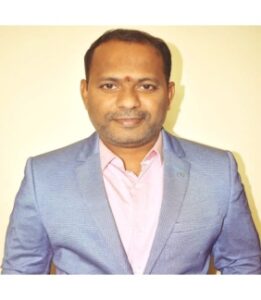
Sri.G.Anand
M.Sc., B.Ed., APSET.,(Ph.D.)
Assistant professor

Smt. V. V. Lakshmi
M.Sc., (Ph.D.)
Assistant professor

Sri.G.Sreenivasa Rao
M.Sc., B.Ed.
M.Sc., B.Ed.

Sri.Ch.Chinnam Naidu
M.Sc., B.Ed., (Ph.D.)
Assistant professor
Sri. S. Suresh
M.Sc., APSET
Assistant professor

Sri.T.Sravan Kumar
M.Sc., B.Ed., APSET.,(Ph.D.)
Assistant professor

Sri.K.Suryanaryana
M.Sc., B.Ed., APSET
Assistant professor

Mr.M.Praveen Kumar
M.Sc., B.Ed.
Assistant professor

Mr. P. Satya Phani Kumar
M.Sc., APSET.,(Ph.D.)
Assistant professor
Sri. R. Ramakrishna
M.Sc., B.Ed.
Assistant professor

Smt. G. Swathi
M.Sc.
Assistant professor

Smt.K.Krishnaveni
M.Sc., B.Ed., APSET
Assistant professor

Smt.T. Devi
M.Sc., B.Ed.
Assistant professor
